ROAD WORKS AHEAD
A new way of working, well suited to complex and risky projects, is being used to carve a $365m motorway extension through some of New Zealand's toughest terrain


SOMETIMES FAMILIAR ways of working just don't cut it any more. When the task ahead is to construct a motorway extension through challenging terrain dubbed tiger country' by engineers and the bush-covered habitats of endangered species, it's worth ditching the old client-contractor model for a partnership that is altogether lighter on its feet.
In the case of New Zealand's northern motorway extension from Orewa to Puhoi, alliance working a partnership approach that puts the project ahead of company priorities is the way ahead.
The Northern Gateway Alliance, comprising Transit New Zealand, Fulton Hogan, URS New Zealand, Leighton Contractors, Tonkin & Taylor and Boffa Miskell, was formed to build a 7km motorway extension north of Auckland that will handle up to 18,000 vehicles a day and relieve pressure on State Highway 1. The four-year project is on target to be completed by late 2008, ahead of schedule.
Transit's Auckland regional manager and Alliance board member Peter Spies says it's a way of working which is still new to New Zealand, but gives far better outcomes than traditional systems. Enthusiasts say it encourages fresh ideas, and reduces blame and cost-driven decisions.
"In our office you wouldn't know who was the client, engineer, designer or contractor," says Spies. "You get a great deal of co-operation, with people willing to share ideas and listen to each other."
Because this stretch of motorway runs north-south and traverses three major east-west ridges, as well as ecologically sensitive land and waterways, the project includes six bridges two of them eco-viaducts twin tunnels and five major culverts. Finding the best design and construction solutions for each of these structures is up to the alliance, says Peter Lipscombe, structures design team leader.
"We had to build a four-lane motorway from A to B, along designated land apart from that, we had a blank canvas," he says. "We knew that safety and speed were key issues the existing State Highway 1 has a bad accident record, so we used the latest geometric modelling to create a very safe road." The design includes barriers to separate oncoming traffic, wide hard shoulders and a road surface of open graded porous asphalt that will stop vehicles aquaplaning in wet weather and reduce traffic noise. The design will also allow traffic speeds of up to 100km/h, while meeting rules on safe sight lines an outcome that was inconceivable at the start of the project.
"No conceptual designs to date had achieved 100km/h design speeds in fact, we'd only managed 90km/h and we didn't think it could be done within budget," says Lipscombe.

First, early project assumptions were challenged, including Transit's formula for aquaplaning, which had been superseded by international best practice. Then a pooling of ideas led to improved geometrics that flattened some of the tight vertical curves and reduced gradients. These design modifications meant reworking the entire mass haul, says project director Andrew McRae. Around 2.4 million cubic metres of earth have been shifted so far, with a further 1.1 million cubic metres due to be moved the same volume of earth removed on the previous 21km of motorway.
Elsewhere, alliance thinking is leading to cost savings, most dramatically at the Waiwera viaduct. A full-size pile was constructed in situ, then pushed into the ground until it failed, to determine the depth the piles needed to be constructed to resist earthquakes. The test avoided the need for a more costly and conservative build and saved the project $100,000.
Environmental considerations are also driving project decisions. Earthworks teams, for example, are using silt fences and sediment control ponds to reduce erosion and control sediment.
"This means less risk of sediment-laden or contaminated water, with less impact on fish life and no silting up of the streams," says McRae.
Vegetation clearance was timed for after the breeding season for the endangered native fern bird, when the chicks had left their nests. To minimise damage to the bush, contractors are working on the motorway's footprint, rather than eating into the land on either side. That puts pressure on teams to work within a smaller area than normal, but means that the project has already saved four hectares of mature bush.
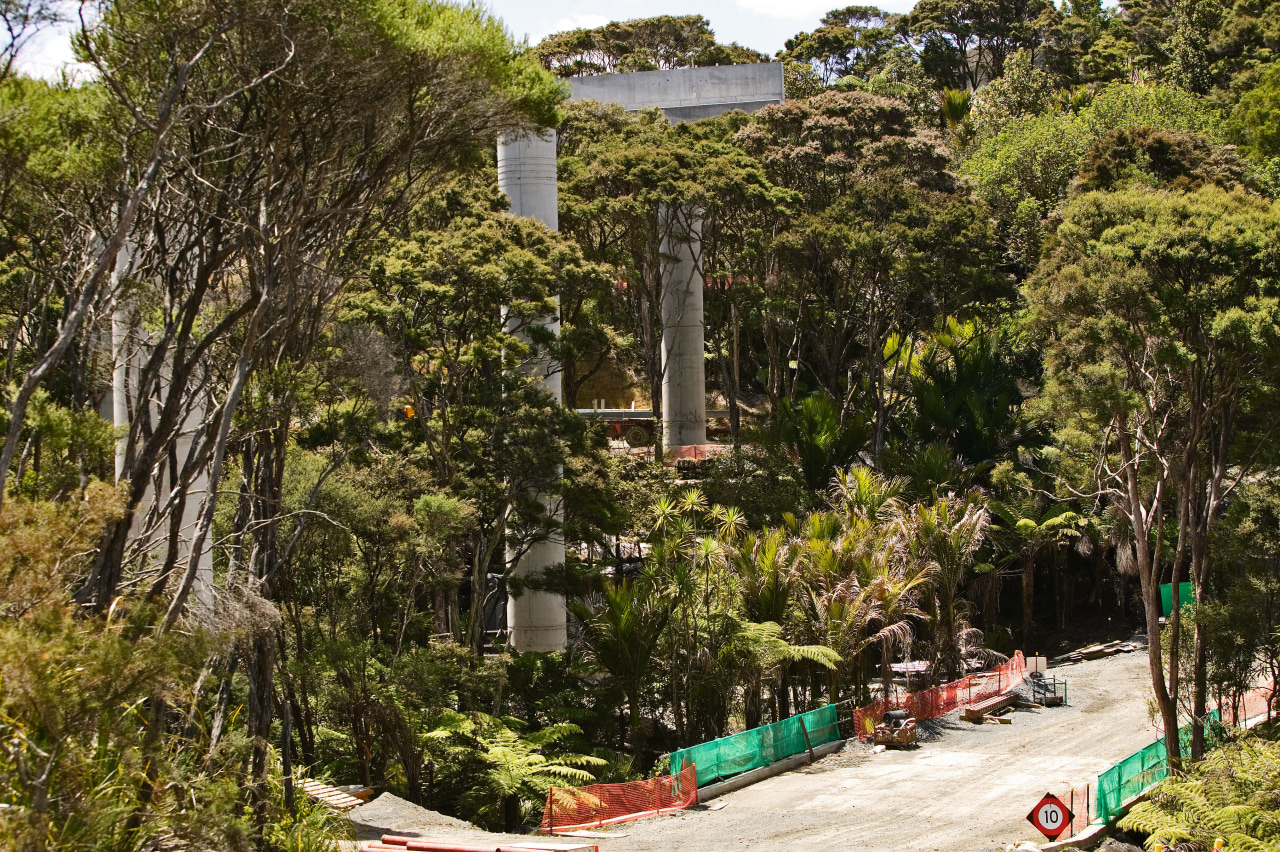
Bridges are also being constructed to minimise disturbance to the bush, particularly the Otanerua eco-viaduct, says Moses Borland, construction manager for structures. There are six bridges in all, including two eco-viaducts that span bush-clad valleys, as well as one that takes the motorway over an estuary, another that traverses local roads, and one that will widen an existing 1930s bridge over a creek.
Bridge construction modifications, such as the use of beam launching trusses rather than cranes on the eco-viaducts, has meant that the amount of vegetation lost is only one-fifth of what would have been allowed under the resource consent conditions. Lean over the barrier, say team members, and the trees are so close you can touch them.
The twin tunnels were also the product of collaborative thinking to protect the environment, says Tony Pink, who has responsibility for tunnelling on the project.

"We were going to put an open cutting through the ridge, but following a rigorous assessment of the added benefits, we obtained approval to change it to a twin tunnel solution to save the southern slope, which was full of mature bush."
Even then, plans were subject to change. The two 350m twin tunnels, one for north- and one for south-travelling traffic, were to have two lanes and no hard shoulder. But with the rest of the extension capable of widening to three lanes in the future, it didn't make sense to have one small stretch blocking that option.
"By working together we were able to find a solution that provided future proofing of the tunnels at no additional cost," says Pink. "We also wanted the tunnels to be the safest in the country. No other tunnels in New Zealand have modern fire suppression, so we took the world's best practice and designed an automatic deluge system that will kick in if heat or carbon monoxide is detected in the tunnel."
A collaborative approach was also used for designing the storm water culverts for fish passages. Traditional methods have their drawbacks, so members of the drainage and environmental teams devised custom-made baffle sheets that are glued to the culvert floor. Every fourth sheet has a collection of rocks, rubble and mud that mimic a fish's natural habitat.
Now at the halfway mark, the project is on target to meet or better its completion date of mid 2009. When the motorway opens, the team has high hopes that the road will look as though it has always been there.
"It's an ironic thing for an engineer to say, but if I can drive my family through the extension and they don't notice the structures, then I'll be pleased," says Spies.
For more information, contact Northern Gateway Alliance, phone (09) 427 3600 or visit the website: www.northerngateway.co.nz.
Story by: Trendsideas

Home kitchen bathroom commercial design